
President Rob Hay’s keynote speech to the ASPS conference on 17 June.
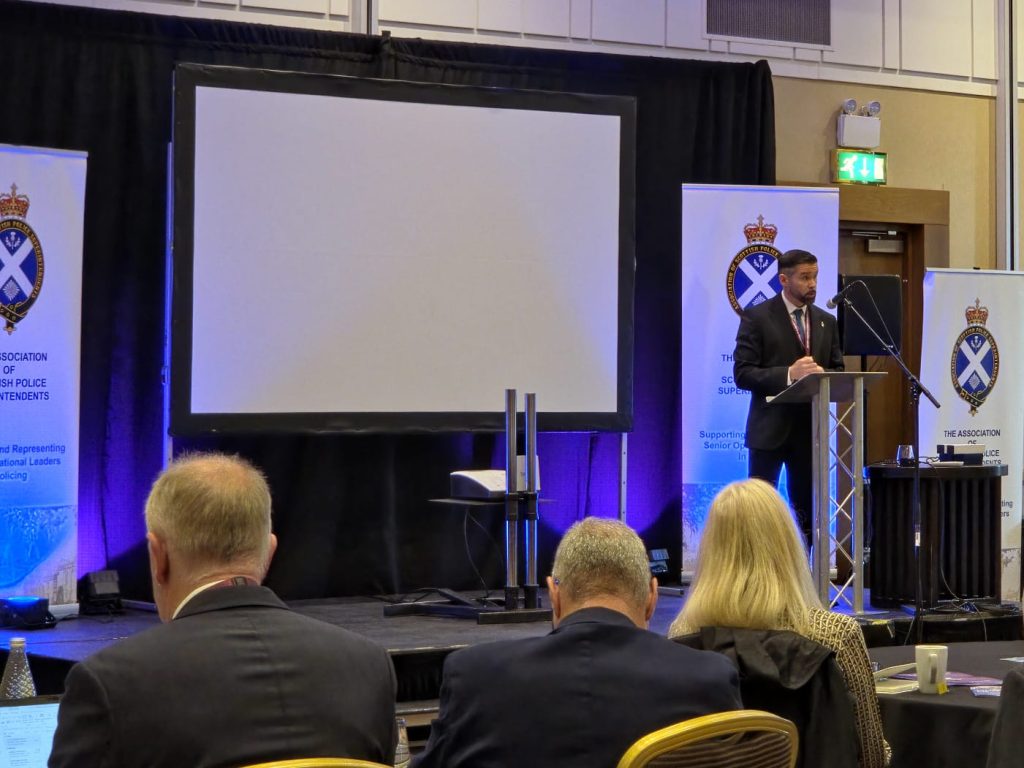
Colleagues, friends and guests, it is my great pleasure to welcome you all to the Westerwood Hotel for the 102nd Annual Conference of Association of Scottish Police Superintendents.
It hardly seems like over a year has passed since I joined you here, but our conference theme “Fit to Lead: Locked in or Burned Out” speaks to the intensity of some of the challenges we have all experienced in the intervening period.
Having shifted our conference forward, to avoid the immediate aftermath of the Scottish elections, we find ourselves meeting in June, rather than May. And as we are joined by our colleagues in the Scottish LGBTI Police Association it would be remiss of me not to wish everyone a happy Pride Month!
At times, it would appear that the climate for under-represented groups is about as hostile as it has ever been in modern times, with modern public discourse more suited for the permanently raging to shout at rainbows.
Despite huge steps forward in recent years with Police Scotland joining other public sector organisations in flying the Pride flag, the current internal Impartiality Review appears to preclude any mention of the occasion. We hope that work is concluded soon. To my friends and my colleagues, know that we see you and the Association stands with you, in both the good times and the bad.
I’d also like to mention our friends at the Police Scotland Sikh Association. The Sikh community have endured a torrent of racist abuse in recent weeks and we know how importance visible support is at times like this.
You will all likely have heard the poem “First They Came” by Pastor Martin Niemoller? Well, when they come for our friends and our colleagues, we stand up and we speak out, because we know how the poem ends.
I’m delighted to be able to welcome the new Cabinet Secretary for Justice, Mr Neil Gray MSP, to conference today. It is the first time I am meeting Neil this morning, so I wanted to start by saying congratulations on your appointment to the role of Cabinet Secretary for Justice and that our Association looks forward to building a productive collaborative relationship with you.
And, similar to your Scottish Government, my membership has just installed me for a further term, so we have that in common. Although, I say with certainty that I won’t have the stamina to stay in the hot seat as long as your party has managed to!
Intense Policing
The last 13 months have been intense in policing and I want to pay tribute to all the ASPS members for their efforts during this time. Not long after our last conference, Scotland once again saw the visit of the US President to Scotland, necessitating a response that impacted across the country. And only a few short weeks after the US Vice-President choose to spend his family holiday in Scotland.
The additional hours worked, cancelled rest days and extended tours of duty highlight not only the commitment and resilience of our cohort, but how thinly stretched we are at times.
Throughout last year an eruption of violence and intimidation linked to serious and organised crime took place across the central belt.
Op Portaledge was created in response and tenacious and painstaking investigative work yielded results as scores of arrests and significant sentences followed. This wouldn’t have been possible without our detective colleagues, often operating furthest from public view, but disrupting those activities and arresting those individuals who pose the greatest risk to the peace and health of our communities.
We again saw the fruits of this type of operation in March this year, when operating in concert with partner agencies such as the NCA, Europol and the Guardia Civil saw arrests in Scotland and Spain. Policing is strongest when it works in partnerships and Police Scotland is very much a part of that international law enforcement community.
Throughout the year the daily business of providing spontaneous command of major incidents continued. Just one example was the co-ordination of the response to the Union Street fire, working with our partners including the Scottish Fire and Rescue Service, British Transport Police, Scotrail and Glasgow City Council, to address an incident that caused major travel disruption across the west of Scotland.
The daily business of delivering policing in Scotland’s towns, cities and villages continued throughout, challenged by falling numbers of resources and budgets stretched at times to breaking point. I pay tribute to all the local senior management teams keeping the ship of local policing afloat against that stormy backdrop.
Finally in review, I want to mention event command and in particular those who command football matches. All volunteers, all aware that in eventful games their every decision will be picked over, not just formal review, but by the armchair commentators across the country, whose bias is visible to everyone but themselves. All aware that those decisions could follow them for years, potentially into retirement.
Your performance at high-stakes games, such as Old Firm encounters and title-deciders has been exceptional. We are all too familiar with the persistent minority of fans who choose to shame their clubs and embarrass our nation.
And I am in complete agreement with our Chief Constable that the sustainable solution to this problem is not a policing one. Of course, we can pour more and more resources into policing games, stripping communities of police officers, in order to support a multi-million pound business.
Or instead, we can ensure those businesses discharge the same duty of care as any other would to patrons attending their premises. Criminal justice outcomes lack immediacy and severity and clearly provide no deterrent in their current form. Footballing problems demand footballing solutions. Points docked, matches forfeit and games played behind closed doors will soon lead to effective self-policing amongst fans. And unlike enhanced policing responses, these solutions are free to the tax-payer and ensure that the “polluter pays”.
So, my plea to our new Cabinet Secretary (who I understand is a fan of the beautiful game) before considering new legislation (that will need to be policed) and new bans (that will need to be enforced), please consider an approach that might actually work over one that only prioritises being seen to act.
Leadership Resilience
This year has seen very different challenges, but they have one thing in common. Every one of them relied upon people stepping forward and accepting responsibility.
Leadership in policing is not exercised from the comfort of hindsight. It is exercised in real time, often with incomplete information, immense scrutiny and significant personal accountability.
That is why protecting leadership resilience matters.
Because if we expect people to carry those responsibilities, we have a duty to create an environment where they can continue doing so, without it having a detrimental effect on their health.
Cabinet Secretary, I’m delighted you could make it this morning and you are very welcome. Your staff were only able to confirm last week you could make it, and our delegates are all very thankful as it was going to be balloon animals and face-painting if you couldn’t make it.
I’m looking forward to getting to know you and I want to offer you the support of our Association, as you get to grips with your new portfolio. We represent the senior operational leaders and that gets you many hundreds of years worth of experience in some of the toughest jobs in policing. I hope you will see the value in our perspective. I offer you our support in your new role and I look forward to working with you over the coming years.
If we are serious about leadership and wellbeing, then we must also be honest about the systems that surround our people.
Because resilience is not just a personal characteristic.
It is shaped by whether institutions do what they are supposed to do when people need them most.
Pension Problems
To that end, one matter I would commend for your early attention is support for the Scottish Public Pensions Authority. Recognising that this isn’t within your direct purview, you are nonetheless our advocate and conduit into the Scottish Government.
We have jointly raised concerns with colleagues in the Scottish Police Federation and SCPOSA, informally and formally in writing, with the Chief Constable, the Scottish Police Authority, the Pensions Scheme Advisory Board, the Public Finance minister and your predecessor regarding the performance of the Agency.
I have writers’ cramp on this topic. Delays to the production of figures necessary for members to complete their tax affairs. The provision of incorrect financial information. The failure to discharge payments to HMRC on behalf of members. The sheer difficulty of getting through on the phone to speak to someone.
For most police officers, their pension is the most valuable financial asset they will ever possess. The subject remains emotive, as the backdrop to this is, for the McLeod Sergeant generation a cohort of officers who have their pension terms changed in a universally detrimental way and now face the Pensions Trap of having the provisions of their legacy scheme work against those of their CARE scheme.
This Association warned for years about the complexities that would follow the changes to police pensions, and yet the agency remained insufficiently prepared. These difficulties have caused their Chief Executive, Stephen Pathirana to be called before the Scottish Parliament twice. However, the case the Association is dealing with now has exhausted our already dwindling well of patience.
One of our members has had to be retired on ill-health grounds in the most grave and serious of circumstances and yet 2 months after their retirement date was still not in receipt of any pension payments.
When an officer reaches retirement, particularly following ill-health retirement in the most serious of circumstances, they should not be forced to fight for the pension they have spent a lifetime earning.
I am happy to report to conference that SPPA CEO, Dr Stephen Pathirana, reached out to me last night to discuss these issues and his programme of change to address them. He assures me that this most recent case is exceptional in nature. I ask for Scottish Government to provide all necessary support to him in this matter and hold the agency to account on delivery.
It is precisely this sort of failure that erodes confidence, damages wellbeing and leaves people questioning whether the system values their service.
Cabinet Secretary, I hope these issues are subject to serious discussion between you and cabinet colleagues.
Policing Priorities
Away from pension matters, I note that Scottish Government will be refreshing the Strategic Police Priorities in this Parliament. I sincerely hope these are crafted with public need and expectation in mind, that they respect the context of the wider criminal justice system and are appropriately resourced.
At the moment, there is a creeping tendency for policing activity to be influenced by pressures elsewhere in the criminal justice system.
Let me be frank – I am done hearing about the level prison population from senior police officers. We should be clear with the public that the rising prison population is being driven by an increase in long-term prisoners, particularly sex offenders and those sentenced for offences linked to serious and organised crime.
These are exactly the sort of people who should be in jail. These are exactly the sort of people most police officers joined to lock up. Their arrest and incarceration is what effective policing and criminal justice looks like.
Our members are concerned that messages about prison numbers will influence policing decisions on our streets. Our job is to keep people safe, but we can only do that if the whole system is oriented the same way. I have heard politicians talk about safety concerns in the prison environment, but what about safety in our communities?
And I have heard politicians of virtually every stripe talk about the safety of women and girls in our society. Like every other decent person I was shocked and disgusted by the recent case in England, where three boys received a non-custodial sentence having been convicted of rape.
But three years ago, that same outcome took place in Scotland, where an individual was given 270 hours unpaid work having been found guilty of rape, because he was under 25. Make that make sense.
But that is the policy environment we are policing in, that is the context to our efforts to keep people safe. Let’s walk the walk on Violence Against Women and Girls and not just talk the talk. Those brave victims that come forward, supported by our colleagues who carry out a painstaking investigation, face a further ordeal in the court room. Let’s ensure that those found guilty face justice commensurate with their crimes and not determined by cell capacity.
I understand Cabinet Secretary that you are leaving our conference this morning to attend the site of the new HMP Glasgow. The additional capacity provided by this facility will be welcome.
Leadership requires clarity of purpose.
Our members need to know that the wider justice system remains aligned to the same objective that motivates police officers and staff every day: keeping people safe.
When that alignment weakens, confidence weakens with it.
Lack Of Parity
My final ask, Cabinet Secretary is that you spare so attention for a matter that has led to a perceived lack of parity of esteem between policing and our fellow public servants in the NHS. As you know the FM declared a public holiday on Monday 15 June and confirmed that colleagues in Scotland’s biggest public sector employer would receive this holiday.
In Scotland’s second biggest public sector employer, policing, police officers recognised that their labour would be needed to ensure the Scottish public could enjoy this and other sporting occasions safely.
Accordingly, the request from Staff Associations was not for the same public holiday, but for an additional 8hrs annual leave, to be taken in the current leave year. However this request has been denied police officers, with the reason being given that the operational impact would be too great to bear.
If our service delivery is really that precariously balanced, I suggest that is an unacceptable risk, warranting immediate action.
These matters are rightly receiving attention through the Police Negotiating Board Scotland, but if it were to receive your attention police officers across Scotland would be hugely grateful. An easy “Quick Win” to start your tenure lays within your grasp.
This is not fundamentally about one day’s leave.
It is about whether police officers feel valued.
And if we are genuinely concerned about retention, wellbeing and creating a thriving workforce, then those perceptions matter.
Conference, I’m glad to say we will be joined by the Chief Constable this afternoon, who will address conference in a private session before joining me for a plenary session and taking your questions.
It’s been a busy week in policing, not just in Scotland but across the UK. I want to recognise the bravery and commitment of those who have mobilised and responded to the upsurge in disorder. Let’s call it what it is: racist violence. It must be utterly condemned and met with the strongest possible policing response. Those who seek to exploit events to stoke divisions and further their own racist agendas deserve nothing but our contempt and should be met with the full force of the law.
As a society, we need to be careful not to legitimise this behaviour through talks of community concerns. If you are only concerned about crime when the victim is white and the offender is a person of colour, we know that racism is the real agenda.
Changes Ahead
In the first half of the year I have been visiting Divisional Commanders, Heads of Departments and SMT’s across the country, as part of an ongoing programme of engagement. I have heard whole-hearted support for the 2030 Vision for policing that the Chief has outlined.
I’ve heard full backing for a common sense approach to increasing operational deployability and address an increasing cohort of modified officers, unable to fulfil the full range of duties of a police Constable. But what I have also heard is an increasing frustration with the gap between rhetoric and reality. Asking managers to change their focus on HR decisions can only work if the policy environment is updated to support it and aligned to employment law.
The formal organisational posture must be clear, as this is what decision-makers will adhere to. To expect anything else is to expect colleagues to accept a level of personal risk that should rightly sit at an organisational level.
In addition, colleagues rising to meet that challenge of an austere budgetary environment profess scepticism that the same rigours lens and challenge applied to overtime is being applied to non-operational parts of the organisation.
The challenge is not persuading leaders to embrace change.
The challenge is ensuring the organisation creates the conditions that allow them to do so safely, consistently and confidently.
Our policies have not fully caught up with our ambitions, so give us the tools and support that lets us make the changes you want to see.
As we support the Chief’s vision of creating a thriving workforce, the key protection for our members is our Workforce Agreement. We hope to see the revised document to receive the Chief’s signature and we would ask that this document receives priority attention.
This document protects members wellbeing and enables the Association to take a position of positively encouraging members to engage in voluntary duties, which are necessary to sustain operational service delivery and, of course, rewarding and beneficial to colleagues policing experience.
There is no more meaningful sign that Police Scotland takes your wellbeing seriously, so let’s get that agreement signed. Protecting people’s resilience is about more than formal documents, but these are the foundation for providing an environment where the workforce can truly thrive.
Being fit to lead does not mean never feeling pressure. It does not mean never feeling exhausted. It means having the support, protections and confidence to continue leading when the challenges come.
The job of your Association is to ensure those conditions exist.
Colleagues, thank you for your attention this morning, it is a privilege to be back representing you this year and I hope I can vindicate your continued faith in me.
Your General Secretary and I have exciting plans for the Association over the coming months, so I look forward to sharing more with you at future events. Meantime, please enjoy your conference today. Thank you!