
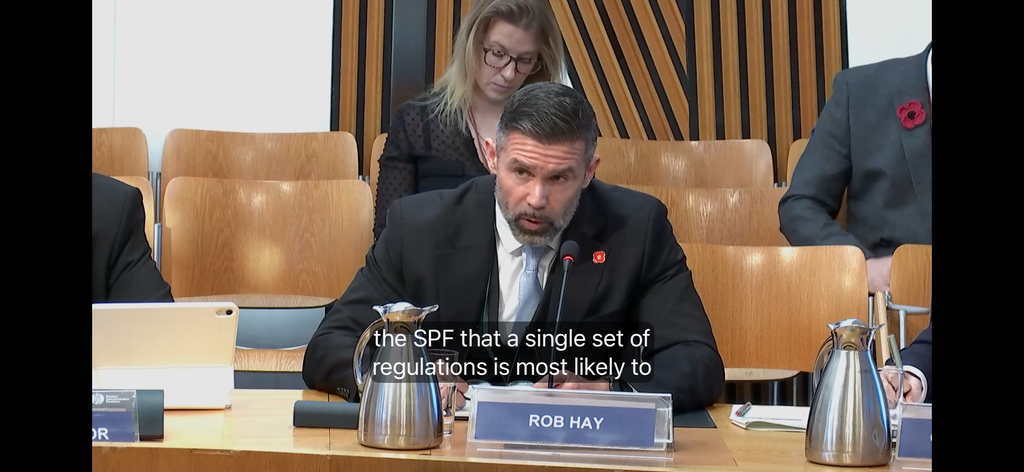
“The code of ethics applies equally to all ranks, and it cannot be the case that the most powerful people in the organisation are the least accountable for their conduct.”
This was the view of Chief Superintendent Rob Hay, President of The Association of Scottish Police Superintendents (ASPS), as he gave evidence to the Scottish Parliament’s Criminal Justice Committee.
The committee met on 28 October to discuss proposed amendments to police regulations that, among other measures, would shift the responsibility for assessing and investigating senior officer misconduct allegations from the Scottish Police Authority (SPA) to the independent Police Investigations and Review Commissioner (PIRC).
Both the conduct regulations and the senior conduct regulations make similar changes, so there was some discussion about combining these two sets of regulations. Rob said he agreed with colleagues in the Scottish Police Federation that a single set of regulations “is most likely to generate fair and just outcomes”. He added that his members would support an independent chair acting in misconduct cases below the senior level too.
He said: “We must do everything we can to ensure the conduct of Scottish police officers is beyond reproach. It is against that backdrop that we consider the new draft regulations.”
Rob continued: “The Association is supportive of the transfer of responsibility for the assessment and investigation of complaints of misconduct by senior officers from the Scottish police authority to the police investigations and review commissioner.
“While such complaints are always few in number, the impact on individuals… is always considerable. And given that, in England and Wales last year, five Chief Constables were all suspended from duty at one point, these are not simply theoretical matters.”
Rob said that his members often felt that if they raised a complaint against a senior officer it would not be dealt with in a fair, timely or transparent manner.
He told the Scottish Parliament about the difficulty in convening any Misconduct Panel that is free from conflict of interest for Superintendents, and particularly Chief Supterintendents. This is due to the small numbers of these officers and the high likelihood of them having worked with those who are then expected to apply objective judgement to a subject officer’s actions.
He pointed to instances where the SPA had decided not to investigate allegations of discrimination, abuse of position, misallocation of police resources or bullying carried out by senior officers. Rob said he believed that, had these allegations been made about a more junior officer, the officer would have been subject to a misconduct investigation and placed under duty restrictions.
He said: “The Association does not accept a differential application for the standards of professional behaviour.
“The code of ethics applies equally to all ranks and it cannot be the case that the most powerful people in the organisation are the least accountable for their conduct. Indeed it might be reasonably argued that the higher the rank an officer holds the greater the responsibility they have to uphold the professional standards of behaviour and lead by example.”